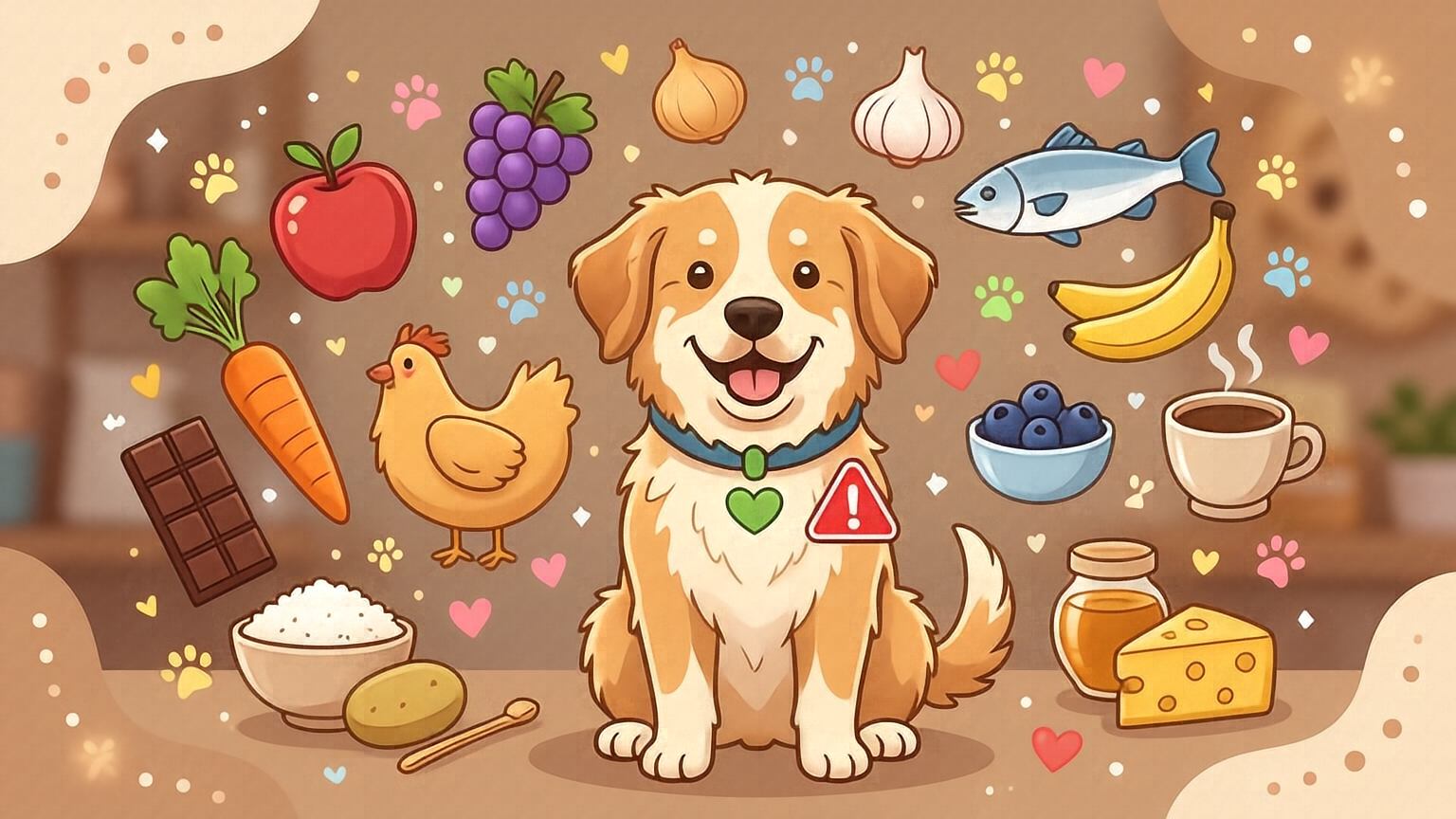
"Can my dog eat bread?" "What about cheese?" "Is that okay if he licked it off the floor?" If you own a dog, you ask this every week. This quick guide answers the 30 most common "can my dog eat…" questions with a clear verdict — yes, no, or yes-with-conditions. Bookmark it and check before you share your plate.
How to read the verdicts
- ✅ YES: safe as an occasional treat when prepped as described.
- ⚠️ IN MODERATION: not toxic itself, but dose, frequency, or preparation make the difference.
- ❌ NO: real risk even in small amounts, or cumulative harm over time.
Quick table: can my dog eat…?
| Food | Verdict | Key point |
|---|---|---|
| Cooked chicken, boneless | ✅ | No salt, no fatty skin, no cooked bones |
| Ham bones | ❌ | Salt + splinters; obstruction and pancreatitis risk |
| Cooked egg | ✅ | Excellent protein; raw only if your vet approves |
| White rice, cooked | ✅ | Great during upset stomachs; not a complete daily diet |
| Pasta, cooked | ⚠️ | Safe plain; mostly empty calories |
| Bread | ⚠️ | Nutritionally empty; raw dough with yeast is ❌ (ferments in the stomach) |
| Cheese | ⚠️ | Low-lactose but high in fat and salt; small training-sized pieces |
| Plain yogurt, no sugar | ✅ | Useful probiotic; never with sweeteners or xylitol |
| Milk | ⚠️ | Most dogs lose lactose tolerance after weaning |
| Peanut butter | ✅ | Only xylitol-free — check the ingredient list |
| Canned tuna | ⚠️ | In water, no salt, occasional: mercury and sodium |
| Cooked salmon | ✅ | Superb omega-3; never raw (parasites — salmon poisoning disease) |
| Sardines | ✅ | Cheap omega-3 bomb; soft bones are fine |
| Prosciutto / cured ham | ❌ | Salt and fat bomb; pancreatitis in sensitive dogs |
| Sausage, salami, cold cuts | ❌ | Salt, fat, garlic, paprika; zero treat value |
| Cooked potato | ✅ | Cooked and peeled only; raw or green is ❌ (solanine) |
| Sweet potato | ✅ | Very digestible; a staple of elimination diets |
| Raw carrot | ✅ | Low-calorie crunch; perfect chewing snack |
| Cooked pumpkin | ✅ | Gentle fiber; great for sensitive digestion |
| Broccoli | ⚠️ | Safe in small amounts; large portions cause gas and irritation |
| Spinach | ⚠️ | Oxalates; go easy for dogs with urinary issues |
| Store-bought mushrooms | ✅ | Supermarket mushrooms, raw or cooked, no sauces |
| Wild mushrooms | ❌ | No foraged mushroom is worth the risk |
| Corn on the cob | ⚠️ | Kernels yes; the whole cob is a classic ❌ obstruction |
| Chocolate | ❌ | Theobromine; the darker, the worse |
| Grapes and raisins | ❌ | Kidney failure; no known safe dose |
| Onions and garlic | ❌ | Hemolytic anemia — including powders |
| Sugar-free gum and mints | ❌ | Xylitol: hypoglycemia and liver damage |
| Plain popcorn | ⚠️ | No butter, no salt, and discard unpopped kernels |
| Ice cubes | ✅ | Safe summer refresher — except for power-chewer teeth |
The three most common mistakes
- Judging by the extreme case. A dog who ate one grape and survived doesn’t make grapes safe: individual toxicity is unpredictable.
- Ignoring the seasonings. Chicken can be ✅ while garlic-chicken is ❌ — it’s the sauce, garlic, and salt that change the answer.
- Confusing "not toxic" with "worth feeding." Bread poisons nobody but contributes nothing: empty treats that displace real food.
The golden rule for foods not on the table
Facing an unfamiliar food, run the quick filter: Does it have a bone or splinters? Salt or seasonings? Sugar or sweeteners? Alcohol or caffeine? Is it a wild mushroom, grape, onion, or chocolate? If any answer is yes, the answer is no. If it’s a plain, cooked, simple food, one bite is probably fine.
And for genuine doubt — medications, plants, mushrooms especially — a vet call costs less than an ER bill.
Bottom line
Most plain, cooked foods are safe for dogs in small amounts; the real dangers concentrate on a short, well-known list: chocolate, grapes, onions, garlic, xylitol, alcohol, cooked bones, and wild mushrooms. This quick table settles 90% of kitchen questions without a 3 a.m. Google spiral.
Educational content based on veterinary sources (PetMD, AKC, ASPCA). Does not replace your vet’s advice.
Leave a Reply